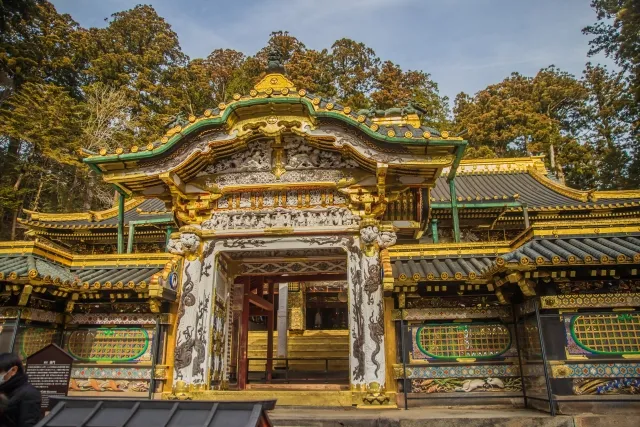
Nikko is a special destination just two hours from Tokyo, harmonizing grand natural scenery with profound history and religious culture embodied by its UNESCO World Heritage sites. In particular, Nikko Toshogu Shrine, dedicated to the founder of the Edo Shogunate, Tokugawa Ieyasu, is not merely a tourist spot, but a grand power spot where art, ideology, and power converge.
This article deciphers the hidden meanings within the shrine’s opulent decorations, provides the most efficient route for touring the World Heritage designated “Two Shrines and One Temple (Nisha Ichiji)”, and explains the essential religious and cultural background you need to know.
Contents
- 1. Deep Dive into Nikko Toshogu: History and Hidden Meanings in the Decorations
- ⛩️ The Pinnacle of Gongen-zukuri: Ieyasu’s Deification and the Grand Shrines
- 🐒 The “Three Monkeys”: Lessons for Life
- 🐈 The “Sleeping Cat”: The Symbol of Peace
- 2. Touring the “Two Shrines and One Temple (Nisha Ichiji)”: Efficient Route
- 🚶 The Most Efficient Pilgrimage Route (Estimated Time: Approx. 3–4 hours)
- 📍 Spot Details (For Confirmation During Your Visit)
- 3. Power Spot Analysis: Feeling Nikko’s Spiritual Energy
1. Deep Dive into Nikko Toshogu: History and Hidden Meanings in the Decorations
⛩️ The Pinnacle of Gongen-zukuri: Ieyasu’s Deification and the Grand Shrines
Nikko Toshogu Shrine was originally founded in 1617, the year after Ieyasu’s death. While initially simple, it was elaborately rebuilt into its current state of vibrant colors and complex architecture—known as the peak of the Gongen-zukuri style—by the third Shogun, Iemitsu. This was a massive national project to enshrine Ieyasu as a deity, “Tosho Daigongen,” and pray for the eternal continuation of Tokugawa peace.
Address: 2301 Sannai, Nikko, Tochigi, 321-1431
Yomeimon Gate:
・Considered one of Japan’s three great architectural gates. It is also called the “Daylight Gate” because visitors could gaze at its detail all day without tiring.
・Over 500 elaborate carvings, many depicting Chinese children (Karako) at play, symbolizing a world of peace.
🐒 The “Three Monkeys”: Lessons for Life
The “See no evil, Speak no evil, Hear no evil” monkeys carved on the Sacred Stable (Shinkyusha) are internationally famous as a symbol of peaceful teachings.
・The Message: This series of carvings depicts the stages of human life. The message of the three monkeys specifically teaches that in childhood, it is best not to see, hear, or speak of bad things (dishonor, gossip, wickedness). This is the foundation of becoming a virtuous person for a peaceful world.
🐈 The “Sleeping Cat”: The Symbol of Peace
The small carving of the “Sleeping Cat (Nemuri-neko)” at the entrance to the Inner Shrine (Okumiya) is traditionally attributed to the famous artisan Hidari Jingoro.
・The Message: The common interpretation is that the cat is a “Symbol of Peace,” indicating that the world is so tranquil that even a cat can sleep soundly. However, there is a subtle layer of meaning: the carving of a sparrow is hidden directly behind the cat, suggesting the deeper lesson, “Do not neglect vigilance, even in peacetime.”
2. Touring the “Two Shrines and One Temple (Nisha Ichiji)”: Efficient Route
The Nikko World Heritage Area is centered on the Two Shrines and One Temple (Nikko Toshogu, Nikko-zan Rinnoji Temple, and Nikko Futarasan Shrine). Here is the most efficient and recommended route to tour all of them (Estimated Time: Approx. 3–4 hours).
🚶 The Most Efficient Pilgrimage Route (Estimated Time: Approx. 3–4 hours)
| Order | Spot Name | Overview and Highlights | Time (Approx.) |
| Start | Shinkyo Bridge (Sacred Bridge) | The iconic vermillion bridge marks the entrance to the World Heritage Zone and the start of Nikko’s power spot trail. | 5 min (Photos) |
| 1. | Nikko-zan Rinnoji Temple | Founded in the 8th century. Visit the “Sanbutsudo,” Nikko’s largest wooden structure, and the “Taiyuin.” | 40 min |
| 2. | Nikko Toshogu Shrine | The main attraction. Includes the Three Monkeys, Yomeimon, Sleeping Cat, and Okumiya (Ieyasu’s Mausoleum). | 90 min |
| 3. | Nikko Futarasan Shrine | Dedicated to Nikko’s three sacred mountains. Located next to Toshogu, known for matchmaking and good fortune. | 30 min |
| End | Toshogu back to the Station | Walk down the road lined with souvenir shops toward the station. |
📍 Spot Details (For Confirmation During Your Visit)
Shinkyo Bridge (Sacred Bridge)
Address: Kamihatsuishicho, Nikko, Tochigi, 321-1431
Note: A separate fee is required to walk across the bridge. Viewing it from the outside is just as worthwhile.
Nikko-zan Rinnoji Temple
Address: 2300 Sannai, Nikko, Tochigi, 321-1494
Note: Requires a separate ticket from Toshogu. Be aware that the main hall (Sanbutsudo) and Taiyuin are separated.
Official Website: https://www.rinnoji.or.jp/
Nikko Toshogu Shrine
Address: 2301 Sannai, Nikko, Tochigi, 321-1431
Note: The central shrine dedicated to Ieyasu. The main attraction of the World Heritage site.
Official Website: https://www.toshogu.jp/
Nikko Futarasan Shrine
Address: 2307 Sannai, Nikko, Tochigi, 321-1431
Note: Entrance to some parts of the grounds is free, but an admission fee is required for the Inner Garden (Shinen).
Official Website: http://www.futarasan.jp/
3. Power Spot Analysis: Feeling Nikko’s Spiritual Energy
Nikko has been revered as a “Sacred Mountain” since ancient times and is counted among Japan’s three most important sacred sites. The area from the Shinkyo Bridge to Futarasan Shrine is particularly said to be filled with strong, life-giving energy.
🌲 Futarasan Shrine: A Power Spot of Tranquility
In sharp contrast to the lavishness and crowds of Toshogu, Nikko Futarasan Shrine is enveloped in a stillness that evokes the roots of ancient Japanese Shinto faith. It enshrines the deities of Nikko’s three sacred mountains and is where nature’s energy remains in its purest form.
Address: 2307 Sannai, Nikko, Tochigi, 321-1431
Recommendation:
Step into the Shinen (Inner Garden)!: Paying the admission fee to enter the Shinen allows you to feel the strong, clean energy and spiritual atmosphere firsthand. We highly recommend visiting the “Enmusubi no Sasa” (Matchmaking Bamboo) and the “Meoto-sugi” (Couple Cedar), power spots dedicated to love, marriage, and household harmony. You will experience a calm, profound Japanese spirit different from that of Toshogu.
🌊 Shinkyo Bridge: The Border to the Sacred Realm
The vermillion Shinkyo Bridge at the entrance to the World Heritage area serves as the boundary to Nikko’s sacred domain.
Address: Kamihatsuishicho, Nikko, Tochigi, 321-1431
Recommendation:
Pause at the Water’s Edge!: This bridge was historically only permitted to be crossed by Shoguns and imperial envoys. Whether you choose to cross it or not, standing by the bridge and gazing at the clear stream allows you to feel a special sense of tension—the boundary between the sacred and the secular. This is the most spiritual “gate” to begin your Nikko journey.
🐉 Yakushido (Crying Dragon): The Acoustic Power of Ieyasu’s Guardian
Dragon carvings and motifs are everywhere in the Toshogu complex. The dragon, a symbol of water and power, is a crucial emblem protecting Ieyasu, who was deified.
・Yakushido (Hongido) “Crying Dragon”: When you clap your hands directly beneath the Dragon painting on the ceiling of the Yakushido Hall, the sound echoes like a dragon’s roar.
Location: Within Nikko Toshogu Shrine Grounds (Follows the Toshogu address)
Recommendation:
Experience a Japanese Power Spot with All Your Senses!: This is a rare Japanese power spot where you feel the energy through sound, not just sight. Follow the guide’s instructions, clap your hands under the dragon, and feel the sonic power of the Dragon God to your core.
✨ Editor’s Picks! 3 Highlights for a Divine Experience at Nikko Toshogu
To maximize your time at Nikko Toshogu, here are three essential experiences that we specially recommend:
1. Stand in Awe before the Yomeimon Gate:
・Stop in front of the Yomeimon Gate, which boasts over 500 carvings, and study the minute details. Feel the underlying narrative of the Tokugawa desire for eternal peace behind the extravagant decorations.
2. Climb the Steps to the Inner Shrine (Okumiya, Ieyasu’s Mausoleum):
・Pass the “Sleeping Cat” and ascend the steep, roughly 200 stone steps to reach Ieyasu’s tomb. These steps symbolize the devotion and strong resolve of the people of that time. The sense of achievement upon reaching the top, combined with the silence of the surrounding cedar forest, is exceptional.
3. Experience the Quiet Majesty of Taiyuin (Rinnoji Temple):
・Taiyuin, built by the third Shogun Iemitsu for his grandfather Ieyasu, intentionally avoids the overt flashiness of Toshogu, opting instead for a stately black and gold color scheme. Step away from the crowds and experience the solemn, tranquil atmosphere, sensing Iemitsu’s deep respect for his ancestor.
この記事へのコメントはありません。