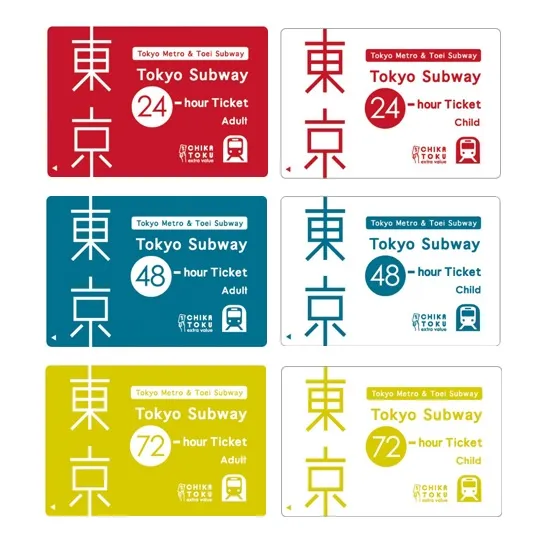
Navigating Tokyo is easiest by subway (Tokyo Metro). While there are many “all-you-can-ride” tickets available, the variety can be confusing for visitors.
This guide thoroughly compares the essential passes, focusing on tickets every foreign traveler should consider. We cover the best deals, exclusive perks, and optimized routes for various travel scenarios.
Contents
1. 🗺️Tokyo’s Subway System Basics: Metro vs. Toei
The subway system spanning Tokyo’s 23 wards is operated by two main companies: Tokyo Metro (9 lines) and Toei Subway (4 lines).
- ・Tokyo Metro (9 Lines): Ginza Line, Marunouchi Line, Hibiya Line, Tozai Line, Chiyoda Line, Yurakucho Line, Hanzomon Line, Namboku Line, Fukutoshin Line
- ・Toei Subway (4 Lines): Asakusa Line, Mita Line, Shinjuku Line, Oedo Line
The subway is indispensable for reaching major spots like Asakusa, Shibuya, and Shinjuku. Choosing a pass that covers both systems is fundamental to efficient sightseeing.
Key Point: IC Cards vs. Unlimited Passes
| Payment Method | Features | Recommended For |
| IC Card (Suica/PASMO/ICOCA) | Convenient, eliminates purchasing tickets every time. Better if your movement involves less than 3 rides a day, or if you plan to frequently use JR lines, private railways, buses, and convenience stores. (Note: Sales for non-tourist IC cards have resumed.) | Travelers making few daily trips, or those prioritizing widespread use (JR, buses, shopping). |
| Unlimited Pass (TST, etc.) | Significantly cheaper if you use the subway many times in a short period. Ideal for concentrated sightseeing within Tokyo’s subway network. | Travelers making 4 or more subway trips per day, focusing on cost savings. |
Latest Update: Welcome Suica Mobile App
The “Welcome Suica Mobile” app (iOS only) is now available for foreign visitors, allowing use of JR lines, private railways, buses, and electronic money without needing a physical card.
- Details (JR East Official Site): https://www.jreast.co.jp/en/multi/welcomesuicamobile/
2. 🎫 Comparison of the 3 Best Tourist Passes
Here we compare the three main passes a tourist should consider for efficient travel around Tokyo.
| Pass Name | Tokyo Subway Ticket (TST) | Tokyo Metro & Toei One-Day Pass | Tokyo Metro 24-Hour Ticket |
| Eligibility | Foreign Visitors Only | Anyone | Anyone |
| Validity Period | 24/48/72 Hours | 1 Day (First to last train) | 24 Hours from start of use |
| Coverage | Tokyo Metro + Toei Subway (All 13 Lines) | Tokyo Metro + Toei Subway (All 13 Lines) | Tokyo Metro Only (9 Lines) |
| Price (Adult) | 72h: ¥1,500 (approx. ¥500/day) | ¥900 | ¥700 |
| Break-Even Point | Approx. 8+ rides over 3 days | Approx. 5+ rides in 1 day | Approx. 4+ rides in 1 day |
| Recommendation | ★★★★★ (The Best Deal) | ★★★☆☆ | ★★☆☆☆ |
The Strongest Choice: Tokyo Subway Ticket (TST)
If you are sightseeing for two days or more, the 72-hour TST (¥1,500) offers the best cost-performance.
Time Advantage: Unlike most Japanese passes which expire at the end of the calendar day, the TST is valid for 72 hours from the moment of first use. This is highly efficient.
Coverage Advantage: It covers both Tokyo Metro and Toei Subway, ensuring access to virtually all major sightseeing spots in the city center.
- Note on Price: The price listed is the base rate. Prices may slightly vary due to commissions or exchange rates if purchased through online travel agencies.
[ATTENTION!] Tokyo Metro & Toei One-Day Pass (¥900)
This pass can be purchased by anyone and is also available as a mobile ticket. For details on purchasing and usage, please check the official website.
- Official Site Information: https://www.tokyometro.jp/en/ticket/value/1day/
[DANGER!] Tokyo Metro 24-Hour Ticket (¥700)
While cheap, this pass does not cover the Toei Subway (crucially, the Oedo Line and Asakusa Line). Since the Toei lines are essential for reaching many tourist destinations, this pass is generally not recommended for sightseers. This ticket can be purchased by anyone at automatic ticket vending machines across all Tokyo Metro stations.
Tokyo Subway Ticket Official Site: https://www.tokyometro.jp/tst/en/index.html
TST Purchase Locations (Passport Required)
The TST cannot be bought at standard vending machines. You must show your passport at the following locations:
- Airports: Tourist Information Centers or counters at Haneda/Narita Airport.
- Central Tokyo: “Commuter Pass Offices” located at major Tokyo Metro stations.
- Online: Online travel agencies (OTAs) such as KKday and Klook (E-ticket needs local exchange).
[Online Purchase Links]
- KKday:https://www.kkday.com/en-us/product/5989-24-48-72-hr-tokyo-subway-ticket-japan
- Klook:https://www.klook.com/en-US/activity/1552-subway-ticket-tokyo/
3. ✈️ Package Tickets Including Airport Access
For travelers heading straight into the city from the airport, package deals combining airport transport and the TST are often the most convenient.
1. Keisei Skyliner & Tokyo Subway Ticket (For Narita Airport NRT)
This set includes the Tokyo Subway Ticket and a ticket for the Keisei Skyliner, the fastest way from Narita to Ueno/Nippori.
- Example Price: Skyliner One-Way + 72h TST: ¥3,600 (Adult)
- Benefit: Cheaper than buying the limited express ticket and the pass separately.
- Purchase Locations: Narita Airport Station, Airport Terminal 2 Station, Skyliner ticket machines/windows at Keisei Ueno and Nippori Stations, and aboard some LCC flights.
- KKday:https://www.kkday.com/en-us/product/5989-24-48-72-hr-tokyo-subway-ticket-japan
- Klook:https://www.klook.com/en-US/activity/1552-subway-ticket-tokyo/
2. Limousine & Subway Pass (For Haneda HND / Narita NRT)
This package combines the TST with a limousine bus ticket, offering direct transport from the airport to various city hotel areas.
- Benefit: Allows easy transfer to your accommodation with heavy luggage, followed by subway use for sightseeing.
- Purchase Locations: Electronic ticket sales only (no physical counter sales).
Limousine & Subway Pass: https://www.limousinebus.co.jp/en/guide/others/ticket/subwaypass/
4. ✨ Maximizing Perks with “Chikatoku”
By showing an eligible subway pass (TST, 24-hour pass, etc.), you can receive special deals and discounts at over 230 tourist spots, shops, and restaurants—this service is called “Chikatoku.”
- How to Use: Simply present your valid subway pass at the counter or shop register on the day of use.
- Example Perks:
- Dining: 10% off at certain restaurants in Maru Building, free cookies at Laforet Harajuku.
- Entertainment: Original goods at Ueno Zoo, entrance fee discount at Asakusa ROX Matsuri-Yu.
- Museums: Discounts on admission at The Ueno Royal Museum, National Museum of Western Art, etc.
Chikatoku Official Site: https://chikatoku.enjoytokyo.jp/en/
5. 🚶♀️ Sample Itineraries Using the Tokyo Subway Ticket (TST)
💡 Important Note on Itineraries
The Tokyo Subway Ticket (TST) does not cover JR lines or private railways. When transferring at major stations like Shinjuku, Shibuya, or Tokyo Station, you will need to use a separate IC card or physical ticket for any JR segments. Please pay close attention to your transfer points when following these routes.
The TST (especially the 72-hour pass) allows for cost-free and efficient sightseeing utilizing Chikatoku perks.
Shopping & Gourmet Route
| Time | Spot | Overview |
| 11:00 | Tokyo Midtown (Roppongi) | Shopping & Lunch. Check the information counter for Chikatoku perks. |
| >>> Subway Transfer (Hibiya Line / Chiyoda Line used) | ||
| 14:30 | Laforet Harajuku (Harajuku) | Shopping, followed by a break, utilizing the Chikatoku free cookie perk at a café. |
| >>> Subway Transfer (Chiyoda Line used) | ||
| 17:30 | Maru Building / Shin Maru Building (Marunouchi) | Dinner with a view of the business district night lights, using a Chikatoku dining discount. |
Art & Culture Route
| Time | Spot | Overview |
| 10:00 | Science Museum (Takebashi) | Explore Japanese technology, using a Chikatoku admission discount. |
| >>> Subway Transfer (Tozai Line used) | ||
| 14:00 | Museum of Contemporary Art Tokyo (Kiyosumi-Shirakawa) | View contemporary art, utilizing a Chikatoku discount for exhibitions. |
| >>> Subway Transfer (Tozai Line used) |
Summary
For travelers frequently using the subway in Tokyo, the Tokyo Subway Ticket (TST) remains the most cost-effective option, easily purchased at airports and major city locations. Additionally, the Welcome Suica Mobile app offers a convenient digital alternative for IC card users.
We encourage you to consider purchasing the TST to ensure a comfortable and budget-friendly trip to Tokyo.
この記事へのコメントはありません。