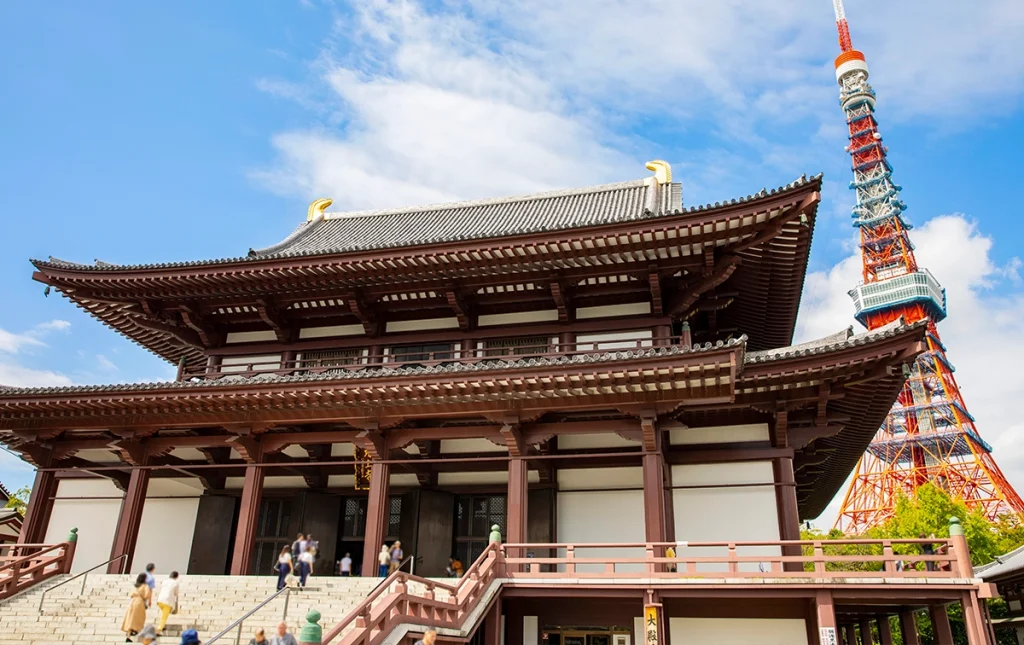
Nestled beside Shiba Park in the heart of metropolitan Tokyo, Zōjōji Temple stands majestically against the backdrop of the modern Tokyo Tower. This unique contrast between the historical past and the present day makes Zōjōji a favorite, highly photogenic destination for visitors.
More than just a sightseeing spot, Zōjōji is a grand head temple of the Jōdo Pure Land Buddhist sect, established during the Muromachi period. It was deeply cherished by Shogun Tokugawa Ieyasu, serving as the Tokugawa Shogunate’s family temple and providing spiritual strength that helped them win crucial battles.
Discover the temple’s hidden importance, the must-see spots, how to get there, and details on its highly sought-after annual events.
The High Status of a Daihonzan: Tokugawa Legacy & Monk Training
Zōjōji holds an exceptionally high religious status, being one of only two temples of its kind in Japan.
⛩️ Why Zōjōji Holds Special Status
Zōjōji is one of the nation’s “Daihonzan” (Grand Head Temples), ranking alongside Chion-in in Kyoto. It holds this unique distinction because it is one of the core training centers for Jōdo Buddhist priests. Since its founding in 1393, it has been central to the development of the Jōdo faith and continues to serve as the required training ground (Dōjō) for monks today.
👑 The Deep Connection to Shogun Tokugawa Ieyasu
When Tokugawa Ieyasu entered Edo (now Tokyo) during the Sengoku period, he designated Zōjōji as the Bodaiji (family grave and memorial temple) of the Tokugawa clan. Consequently, Zōjōji hosted the grand funerals of successive Shoguns, and the graves of several Tokugawa Shoguns (Reibyō) are located on its grounds.
Must-See Spots: History, Power & Photography
The spacious Zōjōji grounds are filled with historically significant sites, offering perfect views of the adjacent Tokyo Tower.
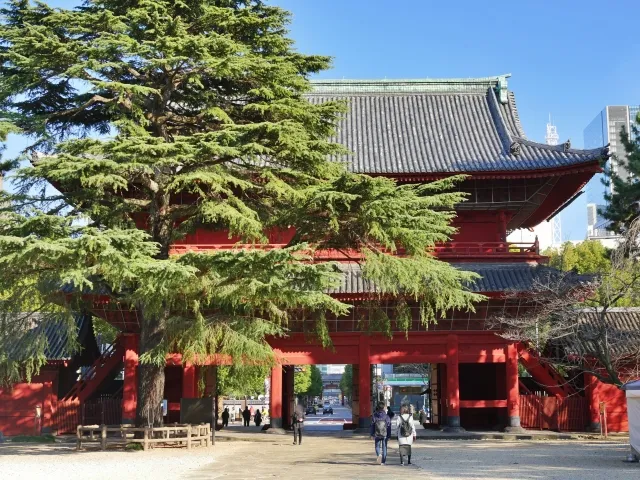
1. Sangedatsumon (Main Gate) — East Japan’s Largest Wooden Gate (Under Restoration)
This historical gate famously survived the Great Tokyo Air Raid and numerous disasters. Though it was once the largest wooden gate in Eastern Japan, it is currently inaccessible to the public.
[Important Notice] Sangedatsumon Restoration Project The gate is undergoing preservation and repair work, covered entirely by scaffolding, from January 2025 to June 2032 (Estimated). Please note that the gate cannot be viewed during this time.
2. Daiden (Main Hall) — The Past Meets the Present
The three-story main hall, enshrining Amida Nyorai, stands at the end of the long straight approach. The contrast of the traditional structure against the soaring Tokyo Tower is an iconic photo opportunity of Tokyo’s cityscape.
The Path’s Secret: The main path from the Sangedatsumon to the Daiden is 48 ken (a unit of measure). This number symbolizes the “48 Vows (Seigan)” that a Bodhisattva must fulfill to attain enlightenment—a subtle yet profound cultural detail.
Daily Services: Morning (6:00), midday (11:30), and evening (17:00) chanting services are held daily by the monks, providing a moment of quiet reflection for visitors.
3. Ankokuden & the “Kurohonzon”: Victory Charms & Souvenirs
The Ankokuden Hall houses the “Kurohonzon” (Black Principal Image), an Amida Nyorai statue that Shogun Ieyasu deeply revered and carried with him during battles.
Named by Ieyasu because it was blackened by years of incense smoke, the statue is venerated as the “Buddha of Kachi-un” (Victory and Good Fortune). Kachi means not only to win battles but also to “excel” or “be superior,” making it popular for those seeking success and prosperity in life.
Viewing the Statue: The Kurohonzon is exhibited only three times a year: on the 15th of January, May, and September.
Omamori and Goshuin:Victory Charms (Kachi-un Omamori) and ceremonial stamps (Goshuin) are available for purchase at the Ankokuden. These charms are popular commemorative items and souvenirs to bring home good luck from your visit.
4. Grounds Exploration: Hidden Gems
Kyōzō (Sutra Repository): A 400-year-old wooden structure that survived the air raids. It housed the rare “Daizōkyō” (a compilation of Buddhist scriptures) from three different historical Chinese dynasties—a priceless collection.
Bamboo Grove and Teikyōan: Behind the Ankokuden, a peaceful bamboo grove leads to the Teikyōan teahouse, which has ties to Princess Kazu no Miya, the wife of the 14th Shogun.
Hōmotsukan (Treasure Museum): Located in the basement of the Main Hall.
5. Zōjōji Treasure Museum (Hōmotsukan)
The centerpiece of the museum is a 1/10 scale architectural model of the Taitoku-in Reibyō (Mausoleum of the 2nd Shogun, Hidetada). Built by his son Iemitsu in 1632, the detailed craftsmanship and glorious ornamentation of this structure are believed to be the prototype for the famous Nikkō Tōshōgū Shrine later built for Ieyasu. The actual mausoleum was destroyed, making this model a priceless historical exhibit.
Hours:11:00 AM – 3:00 PM (Weekdays) / 10:00 AM – 4:00 PM (Weekends/Holidays)
Closed:Tuesdays
Admission:General ¥700 (Set ticket including the Tokugawa Shoguns’ Graves: ¥1,000)
Annual Events: Fantasy Lights and Temple Traditions
Zōjōji hosts various large-scale events throughout the year, often collaborating with the iconic Tokyo Tower illumination.
Event Name
Timing
Details & Participation
Gyoki Daie (Grand Memorial Service)
Annually April 2nd–7th
Zōjōji’s largest ritual commemorating the founder. Includes a magnificent procession of priests from the main gate to the main hall.
Tanabata Festival (Star Festival)
Annually July 6th & 7th
Visitors can write wishes on colorful strips of paper (Tanzaku).
Washi Candle Night
July 6th & 7th (Evening)
A highlight of Tanabata. Free viewing of an ethereal “Milky Way” created by lanterns made of traditional Japanese Washi paper, usually from 6:00 PM to 9:00 PM (Cancelled in case of severe weather).
New Year’s Eve Bell Ringing (Joya no Kane)
Annually December 31st
An opportunity for the public to ring the massive temple bell.
Joya no Kane Tickets (Crucial Info)
Sales start: Typically on the morning of December 1st each year.
Strictly by Reservation. Tickets are highly sought after and often sell out on the first day. If you wish to participate, you must check the official website around mid-November for the exact start date and sales method (online or counter sales).
🚌 Access: Conveniently Located by Multiple Stations
Zōjōji Temple does not have visitor parking, so public transport is highly recommended. It is easily accessible from many major train lines.
Address: 4-7-35 Shibakōen, Minato City, Tokyo
Access:
The closest stations are on the Toei Mita Line: Onarimon Station (A1 Exit) – 5 min walk / Shiba-kōen Station (A3/A4 Exit) – 6 min walk.
Other major stations:
Toei Asakusa/Oedo Line:** Daimon Station (A6 Exit) – 7 min walk.
JR Lines:** Hamamatsuchō Station (North Exit) – 12 min walk.
Tokyo Metro Hibiya Line:** Kamiyachō Station (Exit 3) – 15 min walk.
From Shinbashi Station:** Approx. 22 min walk.
Hours: 9:00–17:00 (Hours may vary during New Year holidays)
Admission: Free for general worship
Official Website: https://www.zojoji.or.jp/
Feature: Temple associated with Ieyasu Tokugawa. Known for “Victory Luck” and features the Important Cultural Property “Sangedatsumon.”
With its expansive grounds rich in history and green space, Zōjōji offers an oasis of tranquility right in the middle of a massive city. Take your time, soak in the atmosphere, and enjoy the unique perspective of Tokyo Tower looming over this powerful historical monument.